For Families
You haven't forgotten them.
We know that.
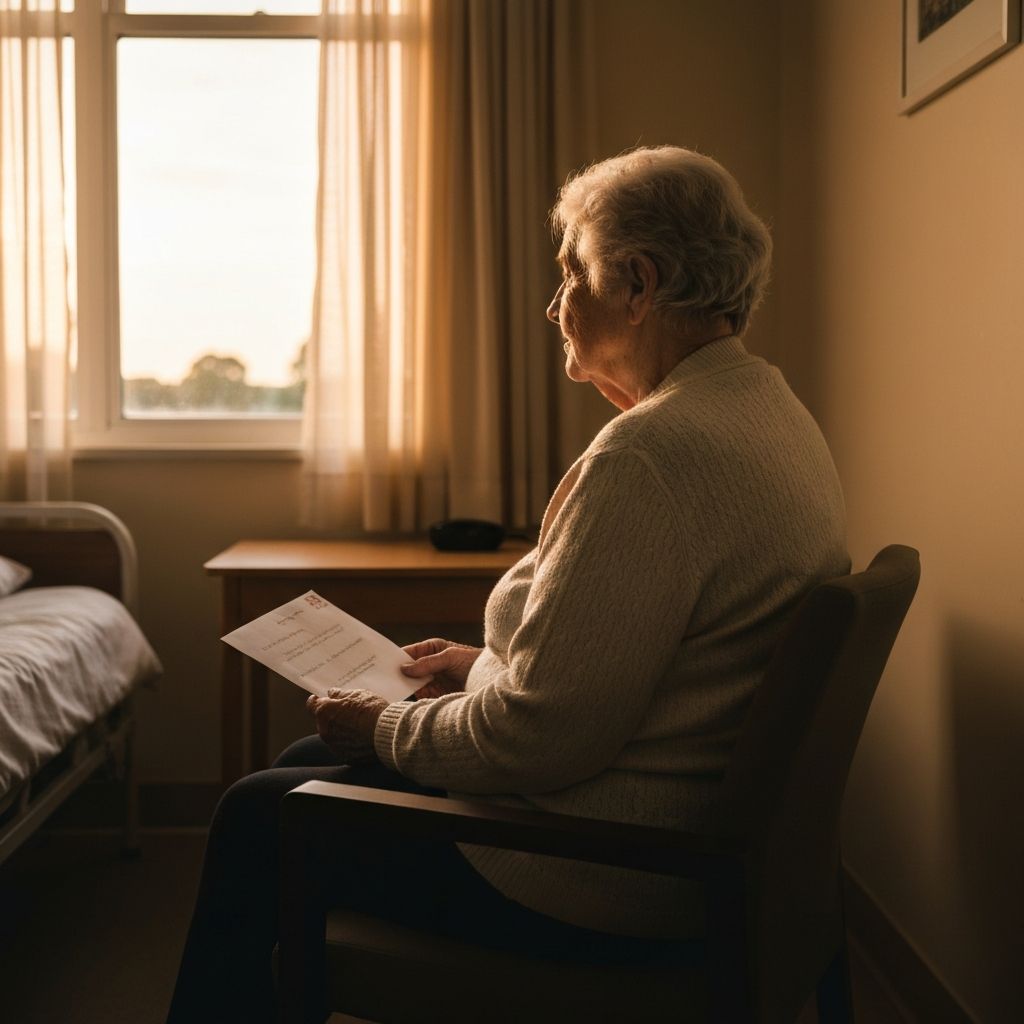
You think about your mother in that room more than anyone realizes. On the drive to work. In the middle of a meeting. At two in the morning when sleep won't come and the guilt arrives instead.
You are not a bad son. You are not a bad daughter. You are a person carrying something heavier than most people will ever understand — and you deserve a way to act on your love that doesn't require you to be someone you can't be right now.

The distance isn't the problem. The silence is.
Your parent knows you have a life. They know about the job, the kids, the mortgage, the thousand daily demands that make a four-hour drive or a cross-country flight feel impossible. Most of them understand this. Many of them will even tell you not to come — that they're fine, that you're busy, that they don't want to be a burden.
But here is what they won't say:
The hardest part of living in a care facility is not the food or the schedule or the room that doesn't feel like home. It is the mail that doesn't come. It is the phone that doesn't ring. It is the slow, corrosive suspicion that the people you spent your whole life loving have moved on — and that you are no longer part of anyone's week.
Roughly one in eight nursing home residents receive no visitors at all. Your parent may not be in that group. But the residents on either side of them likely are. And the loneliness in those hallways is contagious. It seeps under every door.
You cannot fix this with a weekend visit twice a year. You cannot fix it with a phone call your parent can't hear well enough to enjoy. You cannot fix it with a tablet they don't know how to use.
But you can fix it with a letter.
A letter, every week, from someone who learns their name and their story.
Not a card from a stranger. Not a form letter with a printed signature. Not a holiday obligation someone fulfilled and forgot.
A real letter. Written by a real person. Someone who knows your mother was a teacher for thirty years. Someone who asks about the garden she kept, or the song she used to sing, or what she remembers about falling in love with your father.
Someone who writes again next week. And the week after. And the week after that.
Dear Mr. Harrison,
The first frost arrived here this morning, and I immediately thought of you — wondering if you're still the earliest riser on your floor, watching the sunrise from your window. Your daughter mentioned you've kept that habit since your Navy days, when you'd stand watch at dawn. There's something sacred about those quiet morning hours, isn't there?
I've been meaning to ask you about something she shared — how you met your wife Margaret at that USO dance in San Diego. What song was playing? Did you know immediately that she was special, or did it dawn on you slowly over those letters you exchanged while deployed?
Your grandson started college this fall — engineering, following in your footsteps in his own way. Your dedication to craft and precision clearly made its way down the generations. I hope you feel the ways your influence continues to shape the people who love you.
You are deeply valued, Mr. Harrison. Your story matters, your experiences matter, and you are not forgotten.
With respect and warmth,
James
James is not pretending to be family. He is not pretending to be a long-lost friend. Your father will know exactly what this is: someone your family arranged to write to him, because your family wanted to make sure he receives personal attention every single week.
That honesty is the foundation. We never deceive. We never manipulate. We simply show up — on paper, with your parent's name at the top — and we keep showing up until there is no more showing up to do.
The most accessible form of human connection ever designed.
As of 2023, approximately 19 million older adults (32%) lack wireline broadband at home, down from 22 million in 2018. While 90% of adults 65+ now use the internet in some form, the digital divide remains steep among vulnerable populations: only 48% of seniors in households earning under $25,000 annually have home broadband. For the most isolated elders—those with multiple chronic conditions, cognitive impairment, or limited mobility—technology barriers render even "simplified" devices unusable. Your parent may not be able to operate a tablet. They may not hear well enough for phone calls. They may not have the cognitive clarity for a video chat.
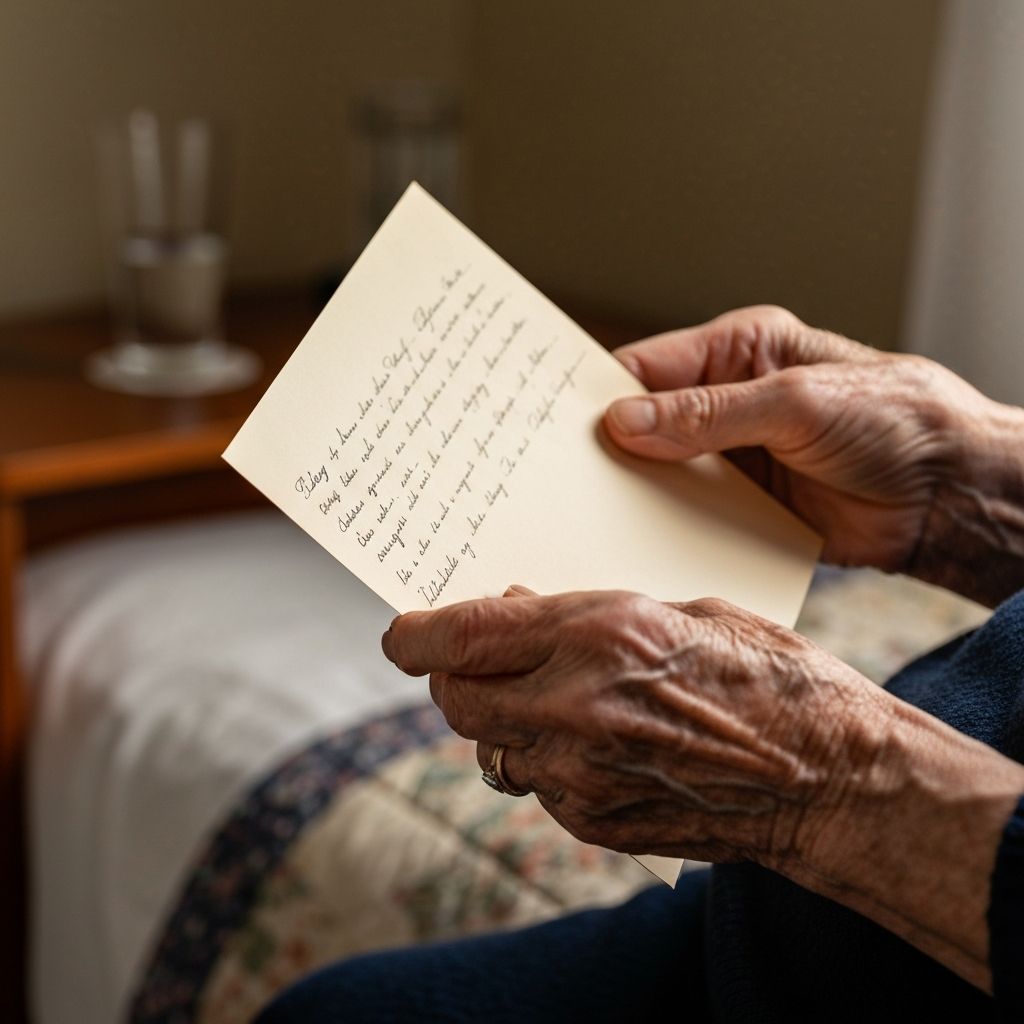
But they can hold a letter.
A letter requires no WiFi. No password. No charging cable. No one to set it up or explain how it works. It arrives in the mail. It can be read alone or read aloud by a nurse. It can be kept on the nightstand and reached for at three in the morning when the hallway goes quiet and the loneliness comes back.
A published case study demonstrated that ten weeks of weekly handwritten letters reduced loneliness scores by 63%—from severe to minimal on the UCLA Loneliness Scale. While this represents a single subject study rather than a large-scale trial, the finding aligns with broader meta-analytic evidence showing reminiscence therapy significantly reduces loneliness in older adults. But the numbers are not why people keep writing to us. They keep writing because their mother called to say "I got a letter today and I read it twice and I'm going to read it again after dinner."
That is what a letter does. It becomes proof — physical, holdable, undeniable proof — that someone out there sat down and wrote her name at the top of a page. That she mattered enough for that.
Choose the depth of connection that fits your family.
Every tier delivers weekly letters from a trained professional writer. The difference is how deeply we learn your parent's story — and how closely you stay involved. All plans are month-to-month. No long-term contracts. Cancel anytime.
Essential Connection
$120-150/mo
Reliable weekly letters with meaningful personalization from a short intake questionnaire. Your parent is addressed by name, their background is honored, and every letter arrives like clockwork.
- 4 professionally printed letters per month on quality stationery
- Personalization from intake questionnaire (name, occupation, hometown, interests)
- Reminiscence prompts tailored to their generation
- Seasonal and holiday acknowledgments
- Monthly summary to you showing letter themes sent
Personalized Journey
$220-280/mo
A dedicated writer assigned exclusively to your parent, guided by a 30-45 minute intake conversation with our care team. Letters reference specific life events, relationships, and memories your family shares with us.
- Everything in Essential, plus:
- Dedicated consistent writer (never rotating)
- Guided intake session with Elder Letters care coordinator
- Letters built from specific life history, family stories, and accomplishments
- Quarterly check-in calls with you to update and adjust
- Self-addressed stamped envelopes so your parent can write back
- Digital copies of every letter emailed to you
- Choice of 5 stationery designs (option to add a family photo)
Legacy & Memory
$400-550/mo
The deepest level of care we offer. A comprehensive family memory workshop gathers stories from you and your siblings. Includes an annual keepsake book of all letters and family photos.
- Everything in Personalized, plus:
- 2-3 hour family memory workshop (multiple family members welcome)
- Letters incorporate specific family stories, traditions, and inside references
- Writer receives family photos, recipes, and meaningful materials
- Monthly themed mailings (vintage family photos, recipe cards, sheet music)
- Annual "Year in Review" keepsake book compiling all letters with photos
- Premium custom stationery with monogram or meaningful imagery
All plans include first-class mail delivery. Add fully handwritten letters for +$180-250/month, or increase to twice-weekly letters for +50% of your plan price. Questions? We would love to talk — reach us at contact.
This is not a replacement for you. It is a way to honor what you cannot do.
We are going to be honest with you, because you deserve that: a letter from a professional writer is not the same as a visit from you. Nothing is. Your parent wants you. And you know that, which is part of why this hurts.
But here is what we also know: you are not going to quit your job. You are not going to move across the country. You are not going to undo the complicated history between you and your parent that makes every visit feel like carrying something you can't put down.
What you can do is ensure that every single week, without fail, someone with training and genuine care sits down and writes your parent a letter that says: you are known. You are valued. Someone arranged for this because they love you.
That is not a consolation prize. That is a gift most elders in this country will never receive.
The families who use our service tell us the same thing, in different words, over and over: "I sleep better knowing Mom gets a letter every Tuesday." Not because the guilt disappears — it doesn't, not entirely. But because the silence does. The awful, empty silence of knowing your parent sits in a room with no mail and no visitors and no proof that their life still matters to anyone.
That silence ends the week you start.
Starting is the easiest part.
You Tell Us About Them
Choose your plan and complete the intake — a short questionnaire for Essential, a guided conversation for Personalized or Legacy. Share what you know: their name, their history, the things that light them up, the topics to avoid. Whatever you can give us, we honor.
We Match a Writer
We pair your parent with a writer whose warmth and style fit their personality. This person becomes their consistent correspondent — not a rotating stranger, but someone who remembers what your parent said last week.
The First Letter Arrives
Within 7-10 days, your parent receives their first letter. We include a note for facility staff explaining the arrangement. You receive a digital copy and confirmation of delivery.
It Continues. Every Week.
Letters arrive on the same day each week. Your parent begins to anticipate them. You receive monthly summaries. Quarterly, we check in with you to learn what has changed — a grandchild's wedding, a health shift, a memory worth weaving into the next letter. The relationship deepens. The silence stays broken.
What we will never do.
Your parent is vulnerable. We know that, and we take it seriously.
Our writers will never pretend to be family. They will never pretend to be old friends. They will never use emotional manipulation to create dependency. The very first letter your parent receives includes a clear, warm explanation: "Your family arranged for me to write to you because they wanted you to receive personal attention every week."
Honor above deception. Always. Your parent deserves to know exactly what this is — and to be moved by the truth of it, not a lie.
If at any point your parent shows distress or confusion about the letters, we pause immediately and coordinate with you and the facility. This service is not for every elder, and we will tell you honestly if we believe it is not right for yours.

"She keeps every letter in a shoebox by her bed. She told her nurse, 'Someone out there knows my name.'"
You already love your parent. That was never the question. The question was what to do with that love when you cannot be there — when the distance and the demands and the heartbreak of watching them age in a place that is not home makes you feel like nothing you do will ever be enough.
A letter will not be enough either. But it will be something. Something real, something consistent, something your parent can hold in their hands and know, with certainty, that they have not been set aside.
Start this week. The silence has gone on long enough.