

Our Mission
Because love cannot wait.
Every day, 2,100 people die in American nursing homes and care facilities.
Most of them leave this world having known a particular kind of loneliness that goes deeper than being alone in a room. It is the loneliness of believing you have been forgotten — not in the casual way of a missed phone call, but in the way that unmakes you. The slow, quiet erosion of feeling that your existence no longer registers in anyone's week. That the people you spent your whole life loving have moved on. That you are no longer part of the story.
Behind the statistics breathe human hearts. A woman who raised four children now wonders whether any of them remember her middle name. A man who built houses with his hands for forty years stares at walls he didn't choose, in a room he didn't want, waiting for someone to ask about the home he misses. A grandmother who baked bread every Sunday can no longer recall the recipe, but she remembers with perfect clarity the feeling of being needed — and the memory visits her every morning like grief.
This is not a market problem. This is a moral crisis of abandonment.
And it is happening five miles from your house. Three miles from your office. In the facility where your mother lives.
Federal survey data shows that roughly one in eight nursing home residents receive no visitors at all, while one in four are visited less than weekly. The numbers understate the problem. Even residents who receive occasional visits report profound loneliness — because sporadic presence, without the rhythm of expectation, can leave a person feeling more forgotten than no presence at all.
The failure is not one of compassion. Families love their parents. Communities care about their elders. The failure is one of infrastructure. Good intentions cannot sustain weekly visits when life intervenes, when distance compounds, when the volunteers who showed up in spring quietly disappear by autumn. Love without scaffolding becomes silence. And silence, to someone sitting alone in a room they didn't choose, sounds exactly like being forgotten.
We build the scaffolding.
What we hold to be true.
We believe that every human being, in every stage of life, possesses inherent and irreducible dignity — not because they are useful, productive, or able to reciprocate, but because they are human. Full stop. No qualifiers. The woman with advanced dementia who cannot remember her own name still deserves to hear it spoken with tenderness. The man who has outlived everyone he loved still deserves to be known.
We believe that loneliness is not a mood. It is a wound. The research is unambiguous — it carries mortality risk comparable to heavy smoking, it elevates dementia risk substantially, it correlates with depression and cognitive decline and the slow, quiet decision to stop trying. But we do not need research to know that being forgotten is among the cruelest things a person can endure. We know it the way we know all essential things — in the body, in the gut, in the part of us that flinches when we imagine it happening to someone we love.
We believe that presence is the foundation everything else rests upon. Not performance. Not programming. Not productivity. The act of sitting with someone, writing to someone, learning someone's name and remembering it next week — this is not a lesser form of care. Without it, medicine is maintenance and activities are distraction.
We believe that consistency is a form of love. Anyone can show up once. The volunteer who visits on Christmas, the friend who calls on a birthday, the grandchild who means to write — these are good things. But the elder who receives attention sporadically learns a harder lesson than the elder who receives none: I matter, but not enough to sustain. We exist to deliver the kind of attention that does not waver. The letter that arrives on the same day, every week, from the same person — that is not a service. That is a promise kept.
We believe that transparency is non-negotiable. Our writers never pretend to be family. They never pretend to be old friends. They never manufacture a false relationship with a vulnerable person. The very first letter explains exactly what this is: someone your family or care facility arranged to write to you, because they wanted to ensure you are seen and remembered. If that truth is not enough to move an elder's heart, no deception would be worthy of it. In our experience, the truth is more than enough.
We believe that this work matters in a way that is hard to overstate. There is something singular about holding a stranger's story. About learning what made someone laugh forty years ago. About writing you are not forgotten to someone who believed they were. We do not have a tidy word for what that act is. We only know that we cannot stop doing it.
The work itself.
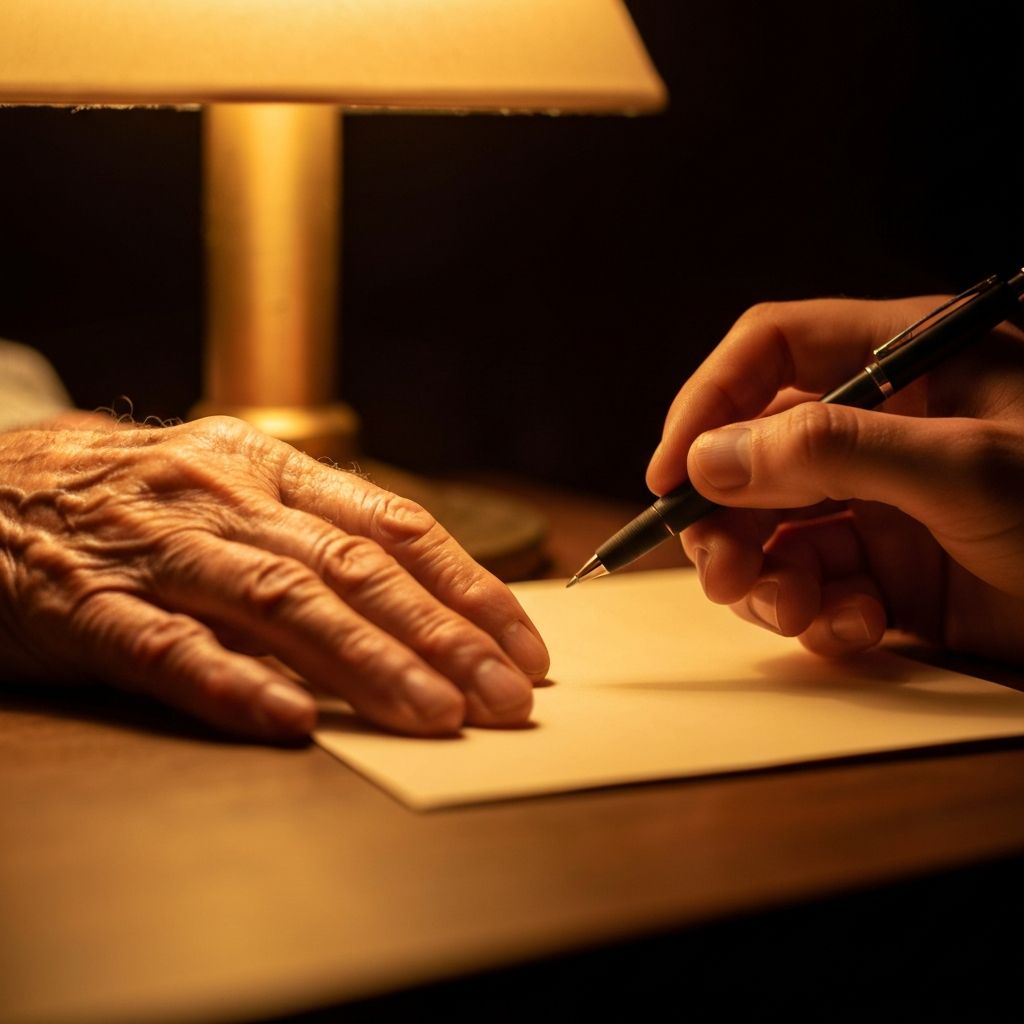
We train and employ professional writers to craft weekly handwritten letters to elders in nursing homes, assisted living facilities, and homebound settings. Each letter is personalized to the recipient's life, history, and story. Each writer maintains a consistent relationship with the elders they serve — the same person, every week, building the kind of familiarity that cannot be manufactured and should never be interrupted.
We partner with families who want to ensure their parent receives reliable personal attention. We partner with care facilities seeking measurable interventions for the loneliness their residents face daily.
We give away free resources — conversation guides, communication training, practical tools — to anyone visiting elders in care, because the need is too large for one organization and too urgent to gate behind a transaction.
And we measure our success not in revenue or growth, but in a question: Are fewer elders dying forgotten because we exist?
If the answer is yes, we continue. If the answer is no, we change until it is.
Our promise.
To the adult child thinking of your parent in that room: you are not failing. You are human, carrying something heavier than most people understand. Let us help you carry it.
To the facility administrator balancing impossible demands: we are not here to judge. We are here to partner — to help you create the culture of care you entered this field to provide.
To the elder wondering whether anyone remembers: someone does. Someone will. You are worth the ink and the paper and the time.
To the writer considering this work: it will change you. It will teach you what matters. It will connect you to lives you would never have known, and it will make your craft feel like the thing it was always meant to be.
We show up. We listen. We remember. We write.
And we do not stop.
Because 2,100 people are dying today. And every one of them deserves to know they were loved.